
ChatGPT Ads Are Here. Now What?

Back in November, we wrote about Sam Altman's comments on OpenAI's monetization strategy. The summary then: OpenAI said they wouldn't take commissions on travel bookings, but they left the door open for ads. We said hotels should prepare for both futures—the one where ChatGPT stays ad-free, and the one where ads become part of the distribution equation.
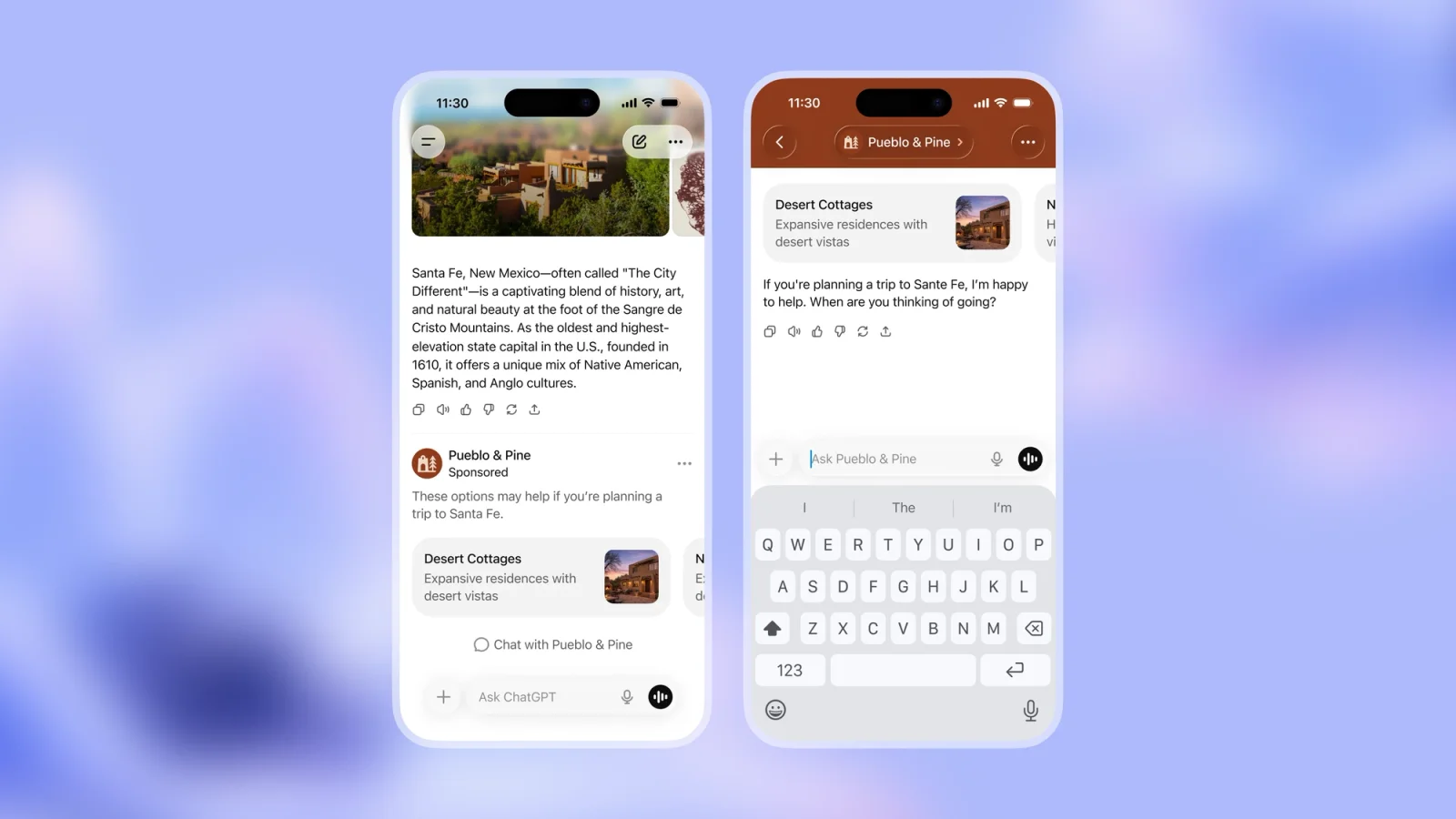
This week, OpenAI made it official: ads are coming to ChatGPT's Free and Go tiers in the U.S. They're launching with a clear principle—ads won't influence answers, and conversation data won't be sold to advertisers. The example they showed? A travel recommendation with a sponsored listing underneath.
But here's the part that matters most: OpenAI said ads won't just be static placements. They wrote:
For example, soon you might see an ad and be able to directly ask the questions you need to make a purchase decision.
Read that again. Interactive ads. The ability to ask questions, check availability, compare rates—all without leaving the conversation. This isn't just a new ad format. It's a new distribution channel, and it runs on infrastructure that hotels either have or don't.
For hotels, this isn't a crisis. It's a clarification. And if you've been building the right foundation, it's a massive opportunity.
What Changed (and What Didn't)
The fundamental dynamic is the same as it's always been: when someone asks ChatGPT "where should I stay in Nashville," the assistant needs to pull from somewhere. That somewhere is either structured, machine-readable hotel data that exists on the web, or it's whatever the model learned during training.
OpenAI's commitment that ads won't influence answers means organic visibility still works the same way it did last week. The assistant is still looking for authoritative, structured, parsable information. If your hotel has that information published in a format AI can understand—schema.org markup, clean inventory feeds, real availability—you still have a shot at being recommended.
What changed is that now there's also a paid layer. When organic recommendations appear, there may also be sponsored listings below them. This is the same playbook that played out with Google over the past 20 years: organic search results coexist with paid placements, and both matter.
What Interactive Ads Will Actually Require
If travelers are going to "ask questions" directly inside a sponsored placement—checking room availability, comparing suite types, understanding cancellation policies—that ad needs to be connected to live data. Not a static image with a link. Live inventory, real pricing, instant responses.
That means three things:
Machine-readable data (MCP): The ad needs to surface structured information that an AI can query—room types, amenities, availability calendars, rate rules. This is what Model Context Protocol (MCP) was built for, and now we will have a way to pipe your first-party MCP directly into a performance advertising experience.
Authentication and booking flows: If a traveler wants to complete a purchase inside the conversation, there needs to be a secure handoff—login, payment processing, confirmation. This will likely be protocol based—Agentic Commerce Protocol (ACP) handles this. But pushing login to your guest in application will be the key to a differentiated ad experience and will turn this from banner advertising into something much more: a completely flat funnel.
First-party data that you control: The hotel needs to be the source. OTAs will come with their own MCP. But their content and rates aren't as good as what you can provide direct. We've long believed that different content is the key. So focus on telling your story and using modern tech that can put that story into this new paid-ad channel.
OTAs Will Be There Day One
Here's what we know for certain: OTAs already operate on feeds, structured data, and machine-readable inventory. They've spent decades building the infrastructure to plug into any distribution channel that accepts programmatic inputs. When ChatGPT's ad platform opens to travel advertisers, OTAs will be ready to buy placement.
And when a traveler clicks a sponsored listing and lands on an OTA page, the dynamic we've documented extensively kicks in: the OTA controls the checkout flow, can strip attribution parameters, and often reroutes the guest away from the hotel's direct channel even if the hotel paid for visibility elsewhere.
The question isn't whether OTAs will show up in ChatGPT ads. They will. The question is whether hotels can compete for that same placement—and whether they can send that click to a first-party destination that actually converts into a direct booking.
Kismet's Approach: The Same Tools Work for Both
The infrastructure you need for organic AI visibility is exactly the same infrastructure you need for paid AI placements.
Think about how this played out with Google. Marketing teams didn't build separate systems for SEO and paid search. They used the same landing pages, the same conversion tracking, the same performance dashboards. The tactics differed, but the foundation was shared.
The same pattern is emerging here. Tomorrow's marketing teams will manage AEO (AI Engine Optimization) and paid chat advertising the same way they manage SEO and paid search today—as complementary strategies running on a shared data and measurement layer.
That's what we're building at Kismet:
1. Make your hotel AI-ready for organic visibilityPublish structured data that assistants can trust. Use schema.org markup for your property details, amenities, and policies. Expose real inventory with accurate availability and rates through MCP. When ChatGPT searches the web to answer "hotels near Broadway with rooftop bars," you want your site to be the clearest, most complete source it finds.
These same feeds, this same structured data, will power your paid placements when you're ready to buy traffic.
2. Prepare your direct channel for AI-originated trafficWhether that traffic comes from an organic mention, a paid placement, or an interactive ad where the traveler is already deep in conversation, the landing experience matters. Kismet gives you ACP-ready checkout flows, authentication that works inside ChatGPT, and inventory that stays in sync. If your direct channel can't offer the same seamless experience as an OTA, you'll lose the conversion even if you won the click.
3. Track where bookings actually come fromAI traffic is different from traditional web traffic. Assistants don't leave clean referrer strings, and attribution can break across redirects. We're building measurement tools that separate "organic ChatGPT consideration" from "sponsored ChatGPT clicks" so you can see what's working, where your spend is going, and how paid and organic strategies reinforce each other.
What We're Watching
OpenAI hasn't published advertiser specs yet, so we don't know the exact mechanics—whether ads will require structured feeds, what schemas they'll accept, or how they'll enforce accuracy for hotel pricing and availability. We also don't know if sponsored listings will open in-chat booking experiences (like ChatGPT Apps) or always route to external websites.
But we're tracking all of it. When OpenAI releases advertiser documentation, Kismet will adapt to support whatever formats and integrations make sense for hotels. Our goal is the same as it's always been: give you the tools to show up where travelers are looking, and make sure that when they find you, they book direct.
Read our full FAQ on ChatGPT Ads →
The Takeaway
We called this in November. We said prepare for both futures—the one where ChatGPT stays ad-free, and the one where ads become part of the distribution equation. Now we know which future we're in, and it turns out the preparation for both futures was identical.
The tools you need to show up organically in AI search are the same tools you need to win in paid AI placements. The structured data, the MCP integration, the ACP-ready checkout, the attribution tracking—it's all the same infrastructure. Hotels that built this foundation for AEO are now perfectly positioned for paid chat advertising.
And here's the reality: travelers are already planning trips in AI assistants—half of them, according to Phocuswright research. Now those assistants are becoming commercial surfaces, and OTAs are ready to compete there. They have the feeds, the data infrastructure, and the checkout flows already built.
The winning move for hotels is to compete on the same terms: be the best source of structured, accurate, first-party hotel data, and make your direct booking experience as seamless as the alternatives. When the assistant is deciding what to trust and where to send the guest—in organic results, in paid placements, in interactive ads—being the source wins.
If you want to start showing up in AI search today, launch your Kismet storefront in 15 minutes. And if you have questions about how interactive ads might affect your distribution strategy, we're here to help you think through it. ---About Kismet: We help hotels show up in AI search and get booked direct. Our platform gives you AI-ready structured data, real-time inventory integration, and clean attribution tracking—so you can compete with OTAs on the same playing field.